
French Defense
The French Defense is Black's response to 1.e4. Let White build a center, then challenge it and attack the pawn chain.
- Play as Black
- 700–2000 Elo
- Solid
- Counterattacking
French Defense
Classical Variation
On this page
- What it is
- Black’s reply 1.e4 e6 2.d4 d5 (ECO C00-C19), building a pawn chain instead of trading in the centre.
- Why people play it
- Solid, low-theory, and rich in plans, you fight for the win as Black without memorising forcing lines.
- Who it’s for
- Players who like recurring structures and understanding over sharp tactics, from 700 to grandmaster.
- The main idea
- Attack White’s centre at its base with …c5 and …f6, while solving the light-squared bishop.
The basics
What is the French Defense in chess?
The French Defense starts 1.e4 e6, and Black almost always follows with 2…d5. It is one of the four main replies to 1.e4, it has been played continuously since the 1834 London-Paris correspondence match, and it remains fully sound at every level.
| Moves | 1.e4 e6 2.d4 d5 |
|---|---|
| ECO codes | C00-C19International classification of French Defense variations |
| Played as | Black, against 1.e4 |
| Character | Closed, strategic, counterattacking |
| White’s main tries | 3.Nc3, 3.Nd2, 3.e5, 3.exd5 |
| Best for | Players who want a clear plan and familiar structures game after game |
| Main drawback | The light-squared bishop on c8 |
Why 1…e6 and not 1…d5 straight away
If Black plays 1…d5 at once, then after 2.exd5 Qxd5 the queen has to come to the centre early. White answers 3.Nc3, developing a knight and hitting the queen with the same move.
In the French, Black plays 1…e6 first. The e6-pawn supports …d5, so after 2.d4 d5 Black challenges the centre with no early queen move.
Playing ...d5 at once
White trades pawns, Black’s queen comes to d5, and Nc3 develops a knight with tempo.
...e6 first
The e6-pawn supports d5, so Black can fight for the centre with a pawn instead of bringing the queen out early.
The pawn chain is the whole opening
Nearly every French position revolves around two facing pawn chains: White on d4-e5, Black on e6-d5. Chains are attacked at the base, so Black strikes d4 with …c5 and e5 with …f6, while White plays on the kingside, where his chain points.
That single rule explains more French moves than any list of variations. It also explains why the opening transposes so freely: the move order changes, the plan does not.
The problem bishop on c8
Black’s one real headache is the light-squared bishop on c8: its own pawn on e6 sits in front of it and blocks the way out. Free that bishop, with …b6 and …Ba6, the …Bd7-b5 route, or simply trading it, and you play with a full army. Forget about it, and you effectively play a piece down. This one problem runs through almost every French line.
Verdict
Should you play the French Defense
Yes. It is theoretically sound, it has never been refuted, and it scores well in practice, particularly below master level, where White often mishandles a closed centre. Engines rate the main lines as roughly balanced, which is all a defence needs to be.
The honest caveat: the French gives White more space in most lines, and space is uncomfortable if you dislike defending. You will spend the opening slightly cramped, waiting for the moment …c5 or …f6 opens the position on your terms. Players who need free pieces by move ten tend to bounce off it.
Style
The kind of game the French gives you
The French produces the same handful of structures game after game: a closed centre, facing pawn chains, and a position that opens when Black decides to break rather than on its own.
What it gives you
- One system to meet 1.e4, instead of a separate answer to each of White’s tries.
- Closed positions whose pawn structures repeat, so the plans repeat with them.
- A clear counterattack: hold the centre, then strike at its base with …c5.
- Ideas that transfer between lines, which is what makes a structure worth more than a move order.
What it asks in return
- Patience: White holds more space in most lines, and it is Black who has to change that.
- A plan for the light-squared bishop, shut in behind its own pawn on e6.
- Timing — the position opens on the break, so a break played too early or too late costs more than a developing move.
- Comfort with a slow start rather than tactics from the first moves.
Personalised
Train the lines you're most likely to face
Without an account you train the main French lines — the ones most players meet. Connect Chess.com or Lichess and OpenlyChess reads your recent games, then trains the variations your own opponents play.


Core ideas
Five ideas that explain every move in the French Defense
Learn these and most French positions become readable without memorised lines.
Support first, strike second
1…e6 exists only to make …d5 safe. Black is not developing, he is buying the right to contest the centre on the next move.
Attack the base of the chain
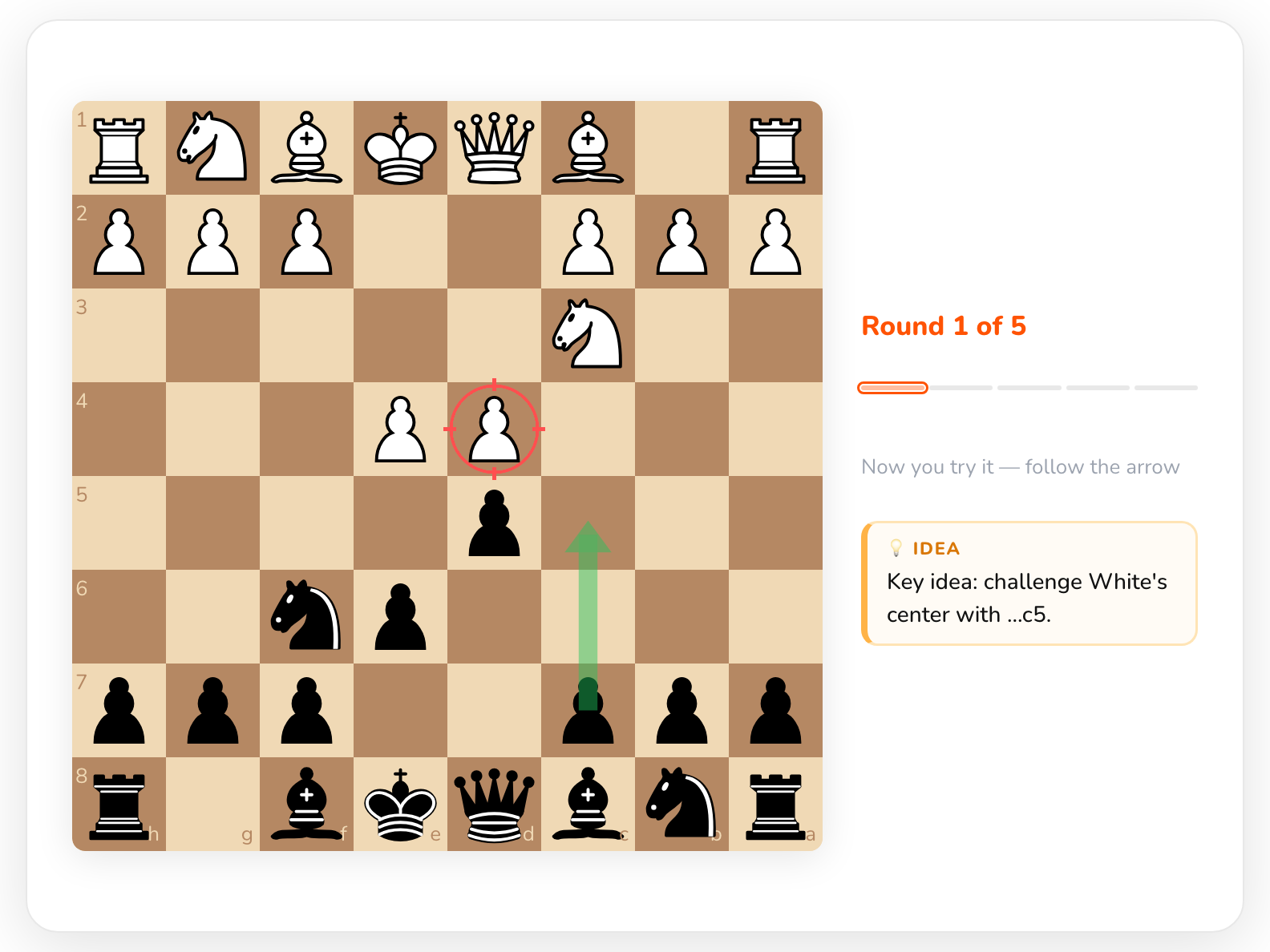
White’s d4-e5 chain rests on d4. Every main Black plan begins with …c5, usually backed by …Nc6 and …Qb6, until d4 collapses.
…f6 is the second lever
When …c5 alone is not enough, Black hits e5 from the other side with …f6. It opens the f-file and often frees the position, at the cost of loosening the king.
Decide the c8-bishop’s route early
The standard solutions are …b6 and …Ba6, the …Bd7-b5 manoeuvre, or a trade after …Bd7. Pick one before castling, not after.
Attack where your chain points
White’s chain points kingside, so he plays f4-f5, Nf3-g5, Qg4. Black’s points queenside, hence …c5, …b5, …a5. Attack on your side, defend on theirs.
Middlegame
Typical plans for both sides
French middlegames are not improvised. Each side has a short list of standard plans, and the game usually goes to whoever completes theirs first.
White’s plans
White: space now, attack later
The same position from the other side. f4-f5 opens lines at Black’s weakest point, Ng5 and Bd3 with Qg4 follow, while c3 and Nf3 keep d4 standing.
- Grab space with e5 and squeeze, Black has fewer squares to manoeuvre in.
- Attack on the kingside: f4-f5, Nf3-g5, bishop to d3 and queen to g4 eyeing h7 and g7.
- Trade dark-squared bishops and exploit the dark squares Black weakens after …Bxc3.
- Hold d4 at all costs, the c3-pawn and the f3-knight prop up the base of the chain.
- In the Exchange, play for a small edge in a symmetrical structure.
Black’s plans
Black: hit the chain at both ends
…cxd4 opens the c-file and strips the base, …f6 attacks the head. Black plays on the queenside and in the centre, where his own chain points.
- Break with …c5 at once and pile on d4 with …Nc6 and …Qb6.
- Prepare …f6 to dissolve the e5-pawn and open files for the rooks.
- Free the light-squared bishop via …b6/…Ba6 or the …Bd7-b5 route.
- Advance on the queenside with …a5 and …b5, or play a minority attack.
- Steer toward the endgame, once queens come off, Black’s structure is usually healthier.
For White
How to beat the French Defense as White
There is no refutation, so the practical question is which system suits you. Three recommendations by playing style:
Advance, 3.e5
Easiest to learn. One plan: hold d4 with c3 and Nf3, then attack on the kingside. Ideal for a club player who wants a system, not a list of lines.
Tarrasch, 3.Nd2
Sidesteps the Winawer pin entirely and keeps a small, safe edge. The choice of Karpov and of anyone who wants a quiet plus.
Classical, 3.Nc3
The most testing and the most demanding. You must be ready for both the Winawer and the Rubinstein, but you get the sharpest game against the French.
Main line
The French Defense main line, move by move
The Classical Variation with 4.Bg5, followed 24 moves deep into the middlegame. Pick any move to see the position and what problem it solves. In training you will have to find these moves yourself.
- 1.
- 2.
- 3.
- 4.
- 5.
- 6.
- 7.
- 8.
- 9.
- 10.
- 11.
- 12.
Starting position. White moves first.
You’ve seen the main line. Now train the key French Defense positions yourself.
Variations
French Defense variations explained
These are the main ways White can respond to your French Defense. Each one changes the position, so each one needs a different plan from Black.
Classical Variation
Black answers 3.Nc3 with 3…Nf6 and hits e4 again. After 4.e5 the knight reroutes and Black strikes at the chain with …c5.
Winawer Variation
Black pins the c3-knight with 3…Bb4 and trades it off for doubled c-pawns. White attacks the kingside, Black that permanent target.
Advance Variation
White closes the center with 3.e5 and gains space. Black attacks the base of the pawn chain with ...c5 and prepares ...f6.
Tarrasch Variation
White plays 3.Nd2 instead of Nc3, so there is no pin to worry about. After …c5 and the trade on d5 the game turns on the isolated pawn.
Exchange Variation
White trades on d5 at once and the centre opens. Black’s problem bishop is finally free, and small plans decide a symmetrical position.
Rubinstein Variation
Black gives up the centre with 3…dxe4 and sidesteps the sharp lines. White gets space, Black a position with no weaknesses at all.
King’s Indian Attack
White ignores the centre and builds with d3, Nd2, Nf3 and g3. A slow build-up to a kingside attack, with little forced theory.
Traps
French Defense traps you should know before your next game
Two punish White, one punishes Black. All three show up regularly in online blitz.
The greedy knight on d4
- 1.
- 2.
- 3.
- 4.
- 5.
- 6.
- 7.
- 8.
- 9.
In the Advance, White holds d4 with pieces. If Black grabs the pawn too early with 7…Nxd4, a check on b5 forks king and queen.
Mistakes
Common mistakes in the French Defense
Five errors account for most of the bad positions you see below 1800.
Developing the c8-bishop last
Black plays …Nf6, …Be7, …O-O and only then notices the bishop has nowhere to go. Choose its route before castling, not after.
Delaying …c5
Without the break Black has no counterplay at all and simply gets squeezed. If …c5 has become impossible, the position is usually already worse.
Playing …f6 too early
The lever only works once Black is developed enough to survive the open f-file. Premature …f6 hands White the e5-square and a target on e6.
White abandoning d4
Moving the f3-knight or the c3-pawn without recounting the defenders of d4 collapses White’s whole structure.
Learning moves instead of structures
The French transposes constantly. Anyone who memorised a move order rather than the logic of the pawn chain gets lost at the first deviation.
Comparison
French Defense vs Caro-Kann: which should you play?
Both are sound, both are closed, and both aim to challenge e4 with …d5. The difference is one pawn: the French supports …d5 with e6 and blocks its own bishop, the Caro-Kann supports it with c6 and keeps the bishop free, but pays a tempo for queenside counterplay.
| French Defense | Caro-Kann | |
|---|---|---|
| First moves | 1.e4 e6 2.d4 d5 | 1.e4 c6 2.d4 d5 |
| Light-squared bishop | Blocked on c8, must be solved | Free, usually …Bf5 or …Bg4 |
| Counterplay | Fast, …c5 in one move | Slower, …c5 costs a second tempo |
| Typical character | Unbalanced, attacking chances for both sides | Calmer, more endgame-oriented |
| Theory load | High in the Winawer, low elsewhere | Moderate and evenly spread |
| Pick it if | You want winning chances as Black | You want comfort and structure |
If you want to play for a win as Black, the French gives you more imbalance to work with. If you want a defence that rarely goes badly wrong, the Caro-Kann is the easier life.
Study plan
How to learn the French Defense
You can be playable in about two weeks. The trick is to learn one line against each of White's four third moves rather than trying to cover everything at once.
Start with the Advance
It is what you will meet most often below 2000, and it teaches the pawn-chain logic in its purest form.
Add the Classical with 4.Bg5
The main line of the opening. Learn where the pieces belong rather than the exact order.
Then the Tarrasch
Different in feel, the centre often opens. One reliable answer is enough at first.
Leave the Winawer for last
Sharpest and most theoretical. It builds on ideas the other three lines teach you.
Review on a schedule, not in one sitting
Opening knowledge decays within days. Short daily reviews at expanding intervals beat one long study session by a wide margin.
Understand the opening. Don’t just memorise moves.
Understand the idea behind each move, then train it until you can find the right decisions in your own games.
Questions
French Defense FAQ
Basics
What is the French Defense in chess?
The French Defense is the opening 1.e4 e6, usually followed by 2.d4 d5. Black supports the …d5 break with a pawn on e6 rather than playing it immediately, which produces a closed centre and facing pawn chains. It is classified C00-C19 and has been a main reply to 1.e4 for almost two centuries.
Why is it called the French Defense?
The name comes from an 1834 correspondence match between London and Paris, in which the Paris team used 1…e6 and won. The move had appeared before, but that match popularised it and the name stuck.
What is the main line of the French Defense?
1.e4 e6 2.d4 d5 3.Nc3 Nf6 4.Bg5 Be7 5.e5 Nfd7 6.Bxe7 Qxe7, the Classical Variation. White takes space, Black prepares the …c5 break. In online games, however, the Advance Variation with 3.e5 is more common.
Strategy
How do you beat the French Defense as White?
There is no objective refutation. Practically: play 3.e5 if you want one clear plan and minimal theory; 3.Nd2 if you want a safe small edge; 3.Nc3 if you are ready for the sharpest lines. Avoid the Exchange with 3.exd5 when you are playing for a win.
Why is the French bishop called bad?
Because the e6-pawn sits on the same colour as the c8-bishop and blocks its main diagonal. Until Black plays …b6 and …Ba6, runs the …Bd7-b5 manoeuvre, or trades it off, the bishop has almost no scope. Solving it is the central strategic task of the opening.
Is the French Defense solid or aggressive?
Both, depending on the line. The Rubinstein and Exchange are calm and solid. The Winawer is one of the sharpest variations in all of chess: Black voluntarily gives up the bishop pair and invites a kingside attack in return for wrecking White’s structure.
Do grandmasters play the French Defense?
Regularly. Wolfgang Uhlmann, Viktor Korchnoi, Rafael Vaganian and Nigel Short built careers on it, and in modern elite practice it appears as a winning attempt when Black wants imbalance rather than a draw.
Variations
What is the Winawer Variation?
1.e4 e6 2.d4 d5 3.Nc3 Bb4. Black pins the c3-knight and usually trades it off, doubling White’s c-pawns. White gets the bishop pair and a kingside attack; Black gets a target and queenside play. It is the sharpest and most theoretical line of the French.
What is the Advance Variation?
1.e4 e6 2.d4 d5 3.e5. White locks the centre immediately and plays for space and a kingside attack. Black answers 3…c5, hitting the base of the chain on d4. White’s plan is easy to execute, which is why club players reach for it.
How do you play against the Advance Variation as Black?
Attack d4 immediately and repeatedly: …c5, …Nc6, …Qb6, and often …Nh6-f5 as a third attacker. Do not rush …f6 before you are developed, and route the light-squared bishop via …Bd7-b5 to trade White’s strong bishop on d3.
French Defense or Caro-Kann, which is better?
Neither is objectively better; both are sound. The Caro-Kann keeps the light-squared bishop active by playing …c6 before …d5, but queenside counterplay comes more slowly. The French gets faster counterplay with …c5 in one move, at the cost of the bad bishop. Choose by what matters more to you, activity or comfort.
Learning
What rating should play the French Defense?
Any. It is especially effective between 700 and 2000, where White often mishandles closed pawn chains, either overextending on the kingside or losing control of d4. At master level the opening is fully sound, but there it becomes a deliberate choice for imbalance rather than a default.
How long does it take to learn the French Defense?
Long enough to understand the pawn-chain logic and one line against each of White’s four third moves — that is what makes the opening playable. The Winawer takes considerably longer. Short, regular reviews hold up better than occasional long sessions.
Where should I start learning the French Defense?
Start with the Advance Variation: you will meet it most often and it explains the basic pawn-chain plan best. Then the Classical with 4.Bg5, then the Tarrasch. Leave the Winawer for last, it is the sharpest and it builds on ideas the other lines teach you.
Can I train the French Defense on OpenlyChess?
Yes. OpenlyChess breaks the French into short one-variation sessions, explains the idea behind every key move, and brings the positions back until they stay in memory. Connect a Lichess or Chess.com account and it prioritises the variations that actually appear in your own games.
About this guide. Explanations are written by the OpenlyChess team. Positions and move sequences are checked automatically and updated together with the trainer. Last updated 11 September 2026.