
Your Opponent Played a Move You Don’t Know. What Now?
Your memorized line is over, but the position is still readable. First see what your opponent changed, then check the threat, and only then return to the plan you learned.
Quick answer
A move you have not seen before does not mean you forgot the opening.
See what your opponent’s move changed. Check whether it threatens anything. If nothing is under threat, go back to what your position was trying to do.
The notation and the memorized line are for after the game.
An opening is not one line
The French Defense, the Sicilian Defense and every other opening are not a single sequence of moves.
After the first few moves your opponent has a choice, and each choice leads somewhere different. That is where an opening’s variations and branches come from.
So if you learned one line and your opponent picked another common continuation, the opening has not ended. You are in a different line of the same opening, with its own good moves and its own plans.
If the move is rare or genuinely unfamiliar, stop trying to continue the sequence you memorized. Look at what the move changed and whether it created a threat. After the game you can study that position and add it to your preparation.
What to do first
When your opponent plays a move you never studied, do not go looking for the right answer from some other position.
Look at the move they just made and ask one question:
A piece may have started attacking one of your pawns. A pawn may have left a square that mattered. A check may have opened up. Something may have appeared that you can take.
Only then decide whether the position needs an urgent reply.
Check the threat
Do not start with "which move did I learn here?". Start with something simpler:
Is my opponent attacking something right now?
- Did they give check?
- Did they attack a piece?
- Is one of your pawns or pieces now undefended?
- Did they open a line towards your king?
If there is a specific threat, answer that first. If there is not, you can go back to the plan your opening was built on.
Answer the check first
Here is what a real threat looks like. The white bishop travels from f1 to b5 and gives check to your king on e8. The squares between them are empty, which is what makes it a check. In notation the move is written 4.Bb5+.
In this particular position you cannot simply carry on with your usual plan. You have to move the king or block the diagonal with a piece.
The move you were about to play, taking on d4 with the pawn from c5, leaves your king in check, so the rules do not allow it at all. You have five legal moves and every one of them answers the check.
Takeaway
When your opponent gives check, getting out of check is the only thing you may do. Go back to the opening plan once that is settled.
Read the position
Say you are Black, playing the French Defense. Here is the whole thing, one move at a time.
Step 1
White strengthens the pawn on d4
White moves the pawn from c2 to c3. It now supports the pawn on d4 from behind, and the centre stands as three pawns in a diagonal line. In notation this move is 4.c3.
Your target is the ringed pawn on d4, because it is what keeps the pawn on e5 alive. The two faint arrows are moves you have not made yet: the knight from b8 to c6 and the queen from d8 to b6, each adding an attacker to that pawn.
Takeaway
While the pawn on d4 is still the target, bring the knight from b8 to c6 and add pressure to it.
Step 2
Your opponent takes your pawn on c5
Your opponent plays something else. The white pawn goes from d4 and takes your pawn on c5. In notation the move is 4.dxc5.
Everything you had prepared was aimed at the pawn on d4, and that pawn is no longer there.
Takeaway
The pawn has left d4. Do not play the next memorized move on autopilot: read the position again first.
Step 3
A new target appears on c5
Look only at what is different. The square d4 is empty, and the pawn that used to stand there is on c5 now — the red arrow is still on the board so you can see where it came from.
That pawn is on your side of the board and nothing is defending it. This is the change, and the answer comes out of it.
Takeaway
A white pawn has appeared on c5. Check whether it is defended before anything else. In this position it is not.
Step 4
The bishop from f8 takes the pawn on c5
Your bishop on f8 can go to c5 and take the white pawn. In notation the move is 4…Bxc5.
After that White and Black have the same number of pawns again, and the bishop has left its starting square and starts taking part in the game.
Takeaway
If your opponent’s move left a pawn or a piece undefended, check whether you can take it and improve one of your own pieces with the same move.
Explore the main lines of the French Defense
The opening page shows its main variations and the idea behind each one, and you choose a training session from there.
Open the French Defense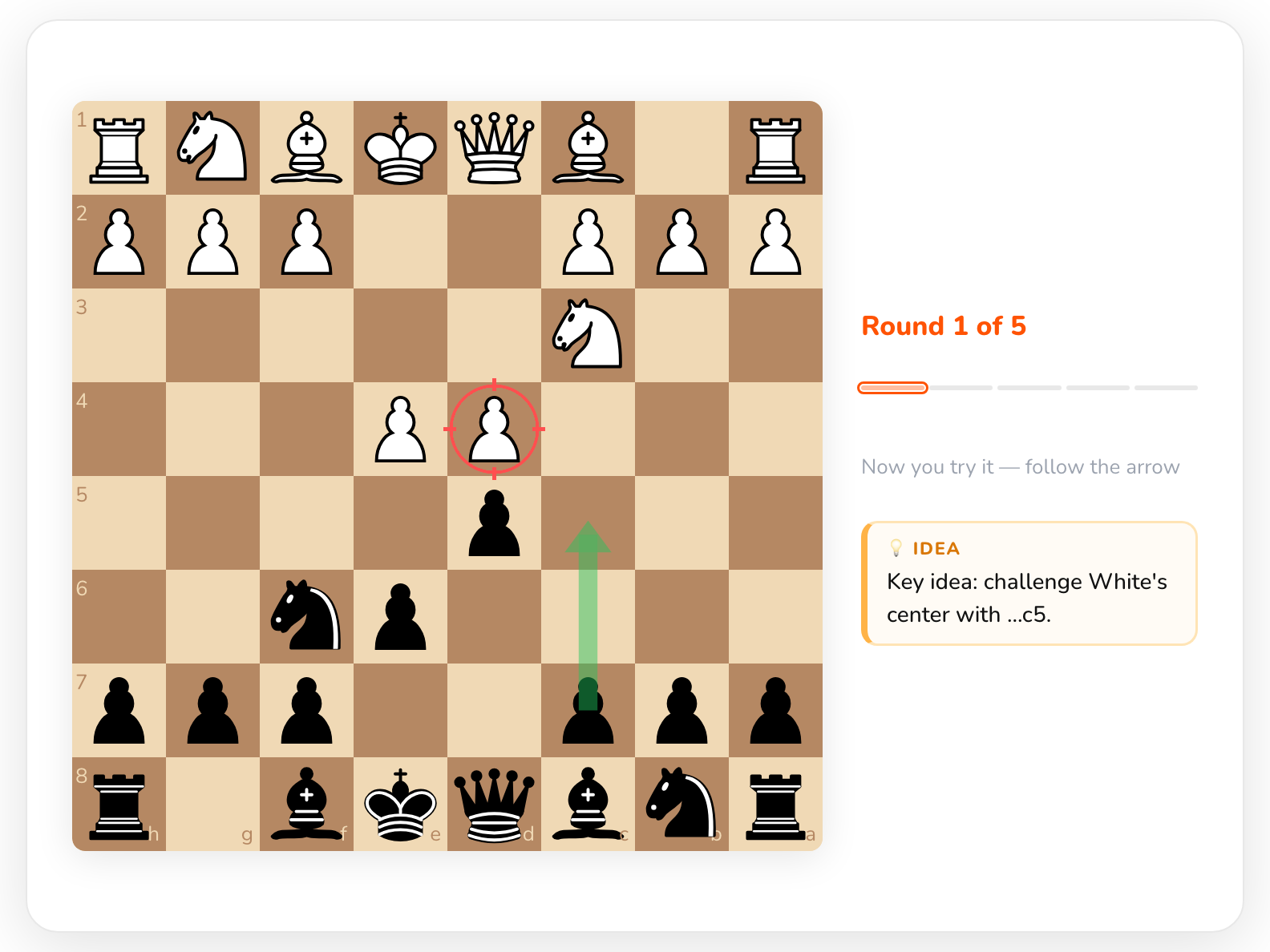
If nothing is threatened, return to the plan
Sometimes your opponent reaches a similar position by a different order of moves. You are not looking for an exact match with what you learned. Compare the parts of the position that matter.
Look for the familiar target
Here White reached the centre by a different order of moves. Your pawns stand where they did — c5, d5 and e6 — and the white pawns on d4 and e5 are in place too.
In the first position the pawn on c3 supported d4. Here White played differently: the pawn on c2 stayed where it was and the pawn from f2 went to f4. So d4 is now defended by pieces rather than by a neighbouring pawn.
The knight from b8 is still worth bringing to c6, because from there it presses on d4.
Takeaway
If nothing is threatened, compare the new position with the one you learned. Here the pawn on d4 is still the target, so the knight from b8 is still worth bringing to c6.
When the plan does not work
The opening plan is only useful once you have checked the threat. If your opponent gave check, attacked a piece, set up a tactic, or left you something you can win on the spot, solve that first.
The bishop coming from f1 to b5 is the clearest version of this: the rules themselves refuse the plan move. Most of the time it is quieter. The odd move attacks something, and your plan move loses a piece. Look again at the check further up for what that looks like on the board.
Recalling
What was the next move in this line?
Reading
What is attacked, and what was I trying to do?
What to save after the game
You do not need to learn the whole opening again. Find one moment:
Which move was the one you did not know?
- Open that position.
- Look at one or two good answers to it.
- Understand why they work.
- Save that position for your next training session.
If the pawn going from d4 to c5 surprised you, you do not need twenty more moves of the French Defense. You need to remember one new position, and why the bishop on f8 can take on c5.
There is a limit to how much of this is worth carrying, and we put a number on it in how many opening moves and positions are worth learning.
Train the opening you actually play
Pick your opening, work through the continuations that come up most often, and practise recognizing the position even when your opponent plays something else.
Choose an openingQuick checklist
Questions
What if my opponent plays a move I have never seen at all?
Check what it changed first: whether it creates a threat, attacks something, or leaves you something to take. If nothing is urgent, carry on developing your pieces and play the plan the position asks for.
How do I tell a different line from a genuinely strange move?
A different line usually keeps the pawns in sensible places and follows a normal idea: taking in the centre, developing a piece, attacking one of your pawns. A strange move often loses time or leaves something undefended. Either way the first step is the same, which is to see what it changed.
Do I need to add a new line to my opening after every game?
No. Add only the positions that actually stopped you, or that keep coming back in your games.
If my opponent’s move is bad, should I look for a punishment straight away?
Only if you can clearly see a specific tactic. Otherwise a normal good move is usually stronger than hunting for a combination that is not there.
How do I learn the plan of an opening if I only know the moves?
That is a sign it is more useful to study a few key positions than one more long line. For each position you should be able to say which pawn or square you are attacking, which piece you are developing, and which trade you want.
Does this only work in the French Defense?
No. The French Defense is just the example here. The order is the same everywhere: see what changed, check the threat, then return to the plan of the position.